ABOUT WATER DAMAGE RESTORATION WHEATON
37 Years of Restoration Experience.
One Clear Purpose: Help Property Owners Recover Properly.
Water damage can turn an ordinary day into a serious property problem in minutes. A burst pipe, flooded basement, failed sump pump or hidden leak can affect more than the surface you can see. Water may move beneath flooring, into drywall, behind cabinets and through other building materials.
That is why Water Damage Restoration Wheaton takes a measured, professional approach from the first conversation.
Led by Haroon and backed by 37 years of restoration experience, our team helps homeowners, property managers and businesses across Wheaton and surrounding DuPage County communities understand what has happened, what needs attention and what should happen next. We focus on practical restoration: inspect carefully, address affected areas based on actual conditions, monitor the drying process and keep the property owner informed throughout the work.
Need help with active water damage?
37 Years of Restoration Experience
IICRC-Certified Technicians
Background-Checked Team
Residential & Commercial
24/7 Emergency Requests
BUILT AROUND CLARITY
Built Around the Part of Restoration Property Owners Often Need Most: Clarity
When water enters a property, the owner usually has several questions at once.
- Our job is not simply to arrive with drying equipment.
- Our job is to help make a complicated situation understandable.
We built our restoration approach around three things that matter on every project: careful inspection, condition-based decisions, and clear communication. That means we do not assume every flooded room needs the same solution. Different materials absorb and release moisture differently, and water may extend beyond the area that looks wet. Professional water restoration therefore requires inspection, moisture assessment, appropriate drying equipment and ongoing evaluation rather than treating every loss the same way. These principles are reflected in the ANSI/IICRC S500 framework for professional water-damage restoration.
Our working principle: Inspect carefully. Dry with purpose. Document the work. Keep the property owner informed.
Where did the water travel?
Is the material still wet underneath?
What needs to be removed?
OUR LEADERSHIP
Led by Haroon. Supported by 37 Years of Restoration Experience.
Experience matters most when it improves the decisions being made on your property.
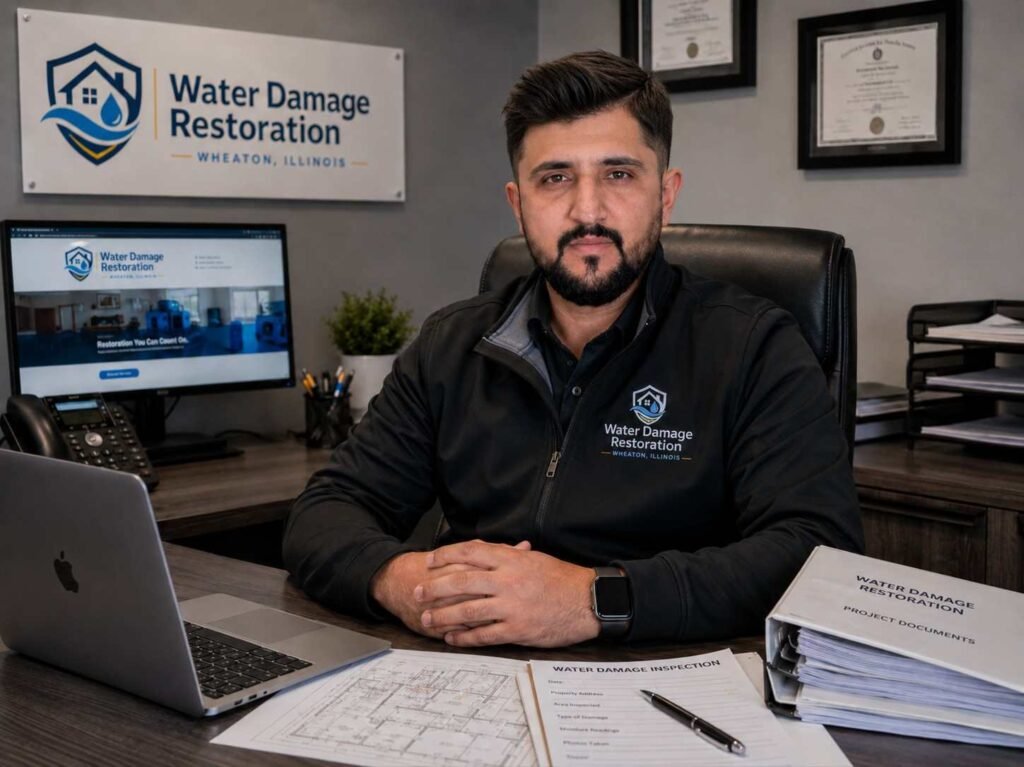
Haroon leads Water Damage Restoration Wheaton with a straightforward expectation for the team: treat every property professionally, explain what we find in language the customer can understand and do not make restoration more complicated than it needs to be.
Our 37 years of restoration experience have reinforced an important lesson: no two water losses should be approached on assumptions alone. A finished basement affected by a sump-pump failure presents different questions from an appliance leak on an upper floor. A commercial water loss may involve different materials, occupancy concerns and drying conditions than a residential bathroom leak. Even two rooms that appear equally wet can behave differently once moisture measurements begin.
That experience shapes how we inspect, plan, communicate and document our work.
OUR STORY
Why We Built Our Approach This Way
Water restoration can become confusing when property owners are given technical terminology without explanation, see equipment placed throughout the building without understanding why, or receive no clear picture of what is being monitored.
We wanted a better experience.
Water Damage Restoration Wheaton is built around a practical restoration model where the property owner knows what the team is looking at, understands the next step and has a clear point of contact. That means decisions are tied to the condition of the property rather than a one-size-fits-all procedure.
It also means documentation is part of the job rather than an afterthought. Photos, affected-area information, moisture readings, equipment details and project notes can help create a clearer record of how the restoration progressed.
Technical terminology without explanation
Equipment without context
No clear picture of what is being monitored
OUR COMMITMENT
Our Mission, Approach and Responsibility
Our work is guided by a simple goal make a difficult property-loss situation easier to understand and manage.
Mission
Help property owners move from uncertainty toward a clearer recovery plan through careful inspection, professional drying practices and straightforward communication.
Approach
Start with the property itself. We look at the source and extent of the water intrusion, affected materials, moisture conditions and practical factors that may influence the restoration plan. From there, the appropriate extraction, drying, monitoring or removal steps can be determined.
Our Responsibility
Respect the property and the people dealing with the disruption. That means showing up professionally, explaining significant findings, keeping project information organized and avoiding promises that cannot be supported by the conditions on site.
WATER IS NOT ALWAYS VISIBLE
Professional Water Damage Restoration Is More Than Removing Visible Water
Standing water is only the obvious part of many water losses.
Moisture can reach carpet padding, subflooring, wall cavities, insulation, trim, cabinetry and other materials that may not look wet from the surface. EPA guidance specifically notes that moisture control is central to limiting mold growth and recommends drying damp or wet materials promptly, generally within 24–48 hours where possible. EPA moisture and mold guidance.That is why our restoration work focuses on the water you see and the conditions you may not see. A professional response may involve water extraction, moisture detection, evaluation of affected materials, air movement, dehumidification and continued monitoring as the property progresses toward appropriate drying conditions.
The goal is not to make a room look dry.
The goal is to make informed decisions based on what is actually happening within the affected area.
Visible water
Standing water, wet surfaces and obvious flooding.
Conditions you may not see
Carpet padding, subflooring, wall cavities, insulation, trim and cabinetry.
Professional drying process
Moisture detection → extraction → air movement → dehumidification → continued monitoring.
WHAT EXPERIENCE HAS TAUGHT US
What 37 Years of Experience Has Taught Us to Pay Attention To
Look beyond the visible damage.
Water can migrate under flooring, behind walls and into adjoining materials. We inspect beyond the obvious wet spot before deciding how limited or extensive the affected area may be.
Understand the material before choosing the response.
Drywall, wood, carpet, insulation, concrete and finished surfaces respond differently to water. The restoration plan should reflect the materials and conditions found on site.
Control moisture rather than relying on appearance.
A surface can feel dry while moisture remains elsewhere in the assembly. Moisture measurements and drying conditions matter.
Explain the next step.
Property owners should understand why equipment is being used, what is being monitored and what the team expects to evaluate next.
Keep the project organized.
Clear photos, readings, notes and scope details help create continuity throughout the restoration process.
This is also why we avoid promising an identical drying time for every project. The affected materials, amount of water, environmental conditions and accessibility of wet areas can all change the restoration plan.
WHAT HAPPENS NEXT
A Clear Path From the First Call to the Next Step
Tell Us What Happened
When you call, tell us what you know: where the water is coming from, when you noticed it, which areas appear affected and whether water is still entering the property. If water is actively entering from a plumbing or building-system problem, the source may need to be stopped by the appropriate plumber, utility or specialist before restoration can fully proceed. The IICRC S500 standard similarly distinguishes correcting the underlying cause of water intrusion from the restorer’s role unless that work is separately contracted.
Inspect the Affected Area
We evaluate visible damage and investigate where moisture may have travelled. The objective is to understand the affected materials and conditions rather than simply responding to the most obvious wet surface.
Explain the Restoration Plan
We explain what we found, what appears to require attention and the proposed next steps. You should know what the team is doing on your property and why.
Extract and Begin Drying Where Appropriate
Depending on the loss, the work may include water extraction followed by professional drying equipment such as air movers and dehumidification. Equipment and placement should relate to actual site conditions rather than simply filling the room with machines.
Monitor Progress
Drying is a process. We monitor relevant conditions and use project information to determine whether the restoration approach should continue or be adjusted.
Keep the Project Record Clear
Important project information is kept organized so there is a clearer record of the affected areas, restoration activities and progress.
PROFESSIONAL STANDARDS
Professional Standards That Matter Inside Your Property
IICRC-Certified Technicians
Our technicians are IICRC certified. The IICRC Water Damage Restoration Technician certification covers water damage, drying structures, sewer backflows and contamination-related restoration knowledge. That technical foundation matters because restoration decisions should be connected to building materials, moisture behavior, drying science and site conditions—not guesswork. Learn about the IICRC WRT certification.
Professional Restoration Equipment
Professional water restoration may involve extraction equipment, air movers, dehumidifiers and moisture-detection instruments according to the conditions identified on site. Equipment is a tool, not the strategy. The strategy comes from determining where moisture is located, which materials are affected and how conditions change during drying.
Background-Checked Team
When technicians enter a home or managed property, trust matters beyond technical ability. Our background-check standard adds another layer of accountability for residential and commercial customers.
Clear Project Records
Documentation supports better communication. We keep relevant project information organized so that changes, findings and restoration progress are easier to follow.
PROPERTIES WE HELP
Residential and Commercial Water Damage Restoration
Water damage does not behave differently just because a building has a different use—but the restoration environment often does.
Residential
In homes, our team may be working around families, finished living spaces, furniture and personal belongings.
Commercial and Managed Properties
In commercial and managed properties, restoration may also need to account for occupants, operating areas, access arrangements, multiple affected spaces and communication with property representatives.
Our approach remains consistent in both settings: assess the property, understand the affected materials, establish a practical scope, communicate clearly and monitor the restoration process.
OUR LOCAL SERVICE AREA
Local Restoration for Wheaton and DuPage County
We are based around the needs of property owners in Wheaton and surrounding DuPage County communities, including nearby areas such as Glen Ellyn, Carol Stream, Winfield, Warrenville, West Chicago, Lombard and Naperville.
Local water problems are not theoretical.
The City of Wheaton specifically identifies basement seepage, sump-pump failure, ejector-pump failure and private-property flooding among issues homeowners may face. The City also notes that stormwater entering the sanitary system can contribute to sewer backups during significant rain events. City of Wheaton flooding information.
That local context is one reason we believe a restoration company should understand more than drying equipment. It should understand the types of water events property owners in the community actually experience.
Wheaton & DuPage County
Basement seepage • Sump-pump failure • Sewer backups
Storm-related water problems identified in local Wheaton guidance.
Wheaton · Glen Ellyn · Carol Stream · Winfield · Warrenville · West Chicago · Lombard · Naperville
COMMON WATER-LOSS EVENTS
Water Damage Problems We Help Property Owners Address
Our restoration work may involve basement flooding, burst pipes, appliance leaks, plumbing overflows, storm and rainwater intrusion, sump-pump failures, hidden moisture, structural drying, flooded-area cleanup and other water-related property damage.
Basement flooding
Burst pipes
Appliance leaks
Plumbing overflows
Storm and rainwater intrusion
Sump-pump failures
Hidden moisture
Structural drying
Flooded-area cleanup
Other water-related property damage
The response should always depend on what is actually found at the property. A small appliance leak and a sewage-affected basement should not be treated as interchangeable events. That distinction is another reason trained technicians, proper inspection and site-specific decisions matter.
HOW WE WORK
What Makes Our Water Damage Restoration Wheaton Different
A lot of companies can place equipment in a wet room.
Our standard is broader.
37 years of restoration experience gives us perspective, but experience only matters when it produces better discipline today. We combine that experience with IICRC-trained technical knowledge, property-specific inspection, clear communication, organized documentation and a local focus on Wheaton and DuPage County.
We do not want customers wondering: What are they doing? Why is this equipment here? Is there still moisture somewhere? What happens tomorrow?
✔ Clear Communication
✔ Respect for Every Property
✔ Condition-Based Decisions
✔ Organized Documentation
✔ 100% Granted Services
✔ No Hidden Cost
We want the customer to understand the process. That is the difference between simply performing restoration work and providing a professional restoration experience.
Property-specific inspection
Clear communication
Organized documentation
Local focus: Wheaton & DuPage County
OUR PROMISE
Our Promise to Property Owners
What we cannot promise
We cannot promise that every material can be saved. We cannot promise that every water loss will dry on the same schedule. And we should not promise that a problem is limited to the area visible from across the room.
What we can promise
What we can promise is a professional process built around investigation, communication and responsible decision-making. We will explain what we see. We will tell you what we believe needs attention. We will document important project information. And when conditions change, we will explain what that means for the next step.
THE PEOPLE BEHIND THE WORK
Real People. Real Restoration Experience.
A Restoration Team You Know Who You’re Calling
When water damage disrupts your property, you should know who is walking through the door.
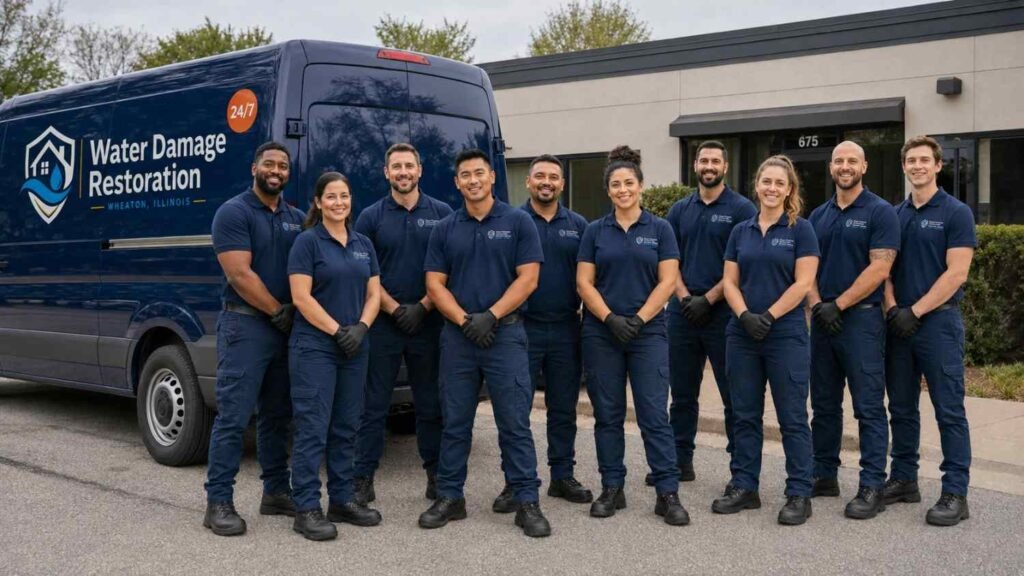
Our team combines 37 years of restoration experience with ongoing technical training and clear operating standards. We expect professional conduct on site, respect for the property and direct communication with the customer throughout the work.
WHEN WATER DAMAGE HAPPENS
When Water Damage Happens, You Need a Clear Next Step
Talk With a Restoration Team Backed by 37 Years of Experience
You do not need to understand moisture science before calling us. Tell us what happened and what you are seeing. We will ask the right questions, help determine the next practical step and arrange service based on the conditions at your property.
Whether you are dealing with a flooded basement, burst pipe, appliance leak, stormwater intrusion, or another water-loss event, Water Damage Restoration Wheaton is here to help you move from uncertainty toward a clear restoration plan.
Wheaton, Illinois • DuPage County and Nearby Communities
37
YEARS OF RESTORATION EXPERIENCE
A clear next step
Tell us what happened and what you are seeing.
A measured restoration process
Careful inspection, professional drying and clear communication.